
The Writesonic review conversation looks very different in mid-2026 than it did just 18 months ago. What launched as an AI writing assistant has undergone a significant transformation, repositioning itself as a Generative Engine Optimisation (GEO) platform designed to help brands appear in AI-generated search results. I spent four weeks testing Writesonic across real content workflows to find out whether this pivot made it more or less useful for the people who originally came to it as a writing tool.
The short answer: it depends on who you are. That answer requires some unpacking.
What Is Writesonic in 2026?
Writesonic launched in 2021 as one of the first wave of AI writing tools, competing with Jasper and Copy.ai for share of the fast-growing content automation market. By 2024, it had built a reputation as the value-focused alternative: comparable output quality at a lower price point, with stronger built-in SEO features than most competitors.
By 2026, the positioning had shifted considerably. The platform now bills itself as an AI Search Visibility Platform, built around a concept called GEO (Generative Engine Optimisation). According to Search Engine Land’s guide to GEO, GEO is the practice of structuring content so that AI-powered search platforms such as ChatGPT, Perplexity, Google AI Overviews, and Gemini can retrieve, cite, and recommend your brand when answering user queries. In plain terms, this means tracking how your brand or content appears across AI search tools, then using AI agents to improve that visibility.
The traditional content creation features are still there. They now sit alongside a suite of brand monitoring and AI search intelligence tools aimed at marketing teams rather than individual bloggers. This matters when you are deciding whether Writesonic is right for you.
Key Features of Writesonic
AI Article Writer 6.0
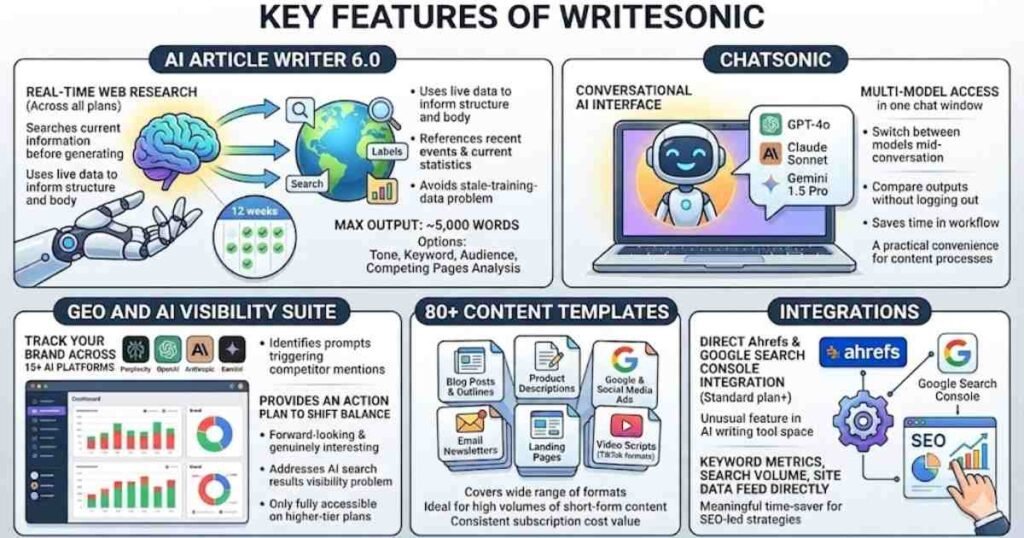
The AI Article Writer remains the centrepiece for anyone using Writesonic to produce written content. Version 6.0, which rolled out earlier in 2026, introduced real-time web research as a standard feature across all plans. This means the tool searches for current information before generating, pulling live data to inform the article structure and body rather than relying solely on training knowledge.
In my testing, this was one of the most noticeable improvements over earlier versions. Articles produced with Article Writer 6.0 referenced recent events, used current statistics, and avoided the stale-training-data problem that still affects simpler AI writers. I ran 12 article drafts through it over four weeks and found the factual accuracy noticeably better than what I had seen from the tool in late 2024. Maximum output length sits at around 5,000 words per generation, with options to set tone, target keyword, audience, and competing pages to analyse.
Chatsonic
Chatsonic is Writesonic’s conversational AI interface, and in 2026 it has become genuinely useful in a way that earlier iterations were not. The key development is multi-model access within a single chat window. You can switch between GPT-4o, Claude Sonnet, and Gemini 1.5 Pro mid-conversation without logging out or opening a separate tool.
I found myself using this more than expected. The ability to run the same brief through different models and compare outputs in one interface saved real time in my workflow. It is a small but meaningful quality-of-life improvement over maintaining separate subscriptions or tabs. If you use Claude AI regularly as part of your content process, having it accessible alongside other models in a single window is a practical convenience worth noting.
GEO and AI Visibility Suite
This is where Writesonic has staked its 2026 differentiation. The AI Visibility Suite tracks your brand across more than 15 AI platforms, showing you which prompts trigger competitor mentions rather than your own, and providing an action plan to shift that balance. According to G2’s 2026 listing, this suite is one of the features that most distinguishes Writesonic from comparable AI content tools at this price point.
The feature is forward-looking and genuinely interesting. It is also only fully accessible on higher-tier plans, which limits its relevance for freelancers and small teams on tighter budgets. For marketing managers at brands with proper budget, it addresses a real and growing problem: AI search results are increasingly the first touchpoint for buyers, and most brands have no visibility into how they appear (or do not appear) in those results.
80+ Content Templates
The template library covers a wide range of formats: blog posts and outlines, product descriptions, Google and social media ad copy, email newsletters, landing pages, and video scripts including TikTok formats. For anyone producing high volumes of short-form content, this is where Writesonic earns its subscription cost most reliably and consistently.
Integrations
Writesonic integrates directly with Ahrefs and Google Search Console on the Standard plan and above. This is unusual in the AI writing tool space. Most comparable tools treat SEO data as an afterthought or charge extra for integration. Having keyword metrics, search volume, and site data feeding directly into the content generation workflow is a meaningful time-saver for anyone running an SEO-led content strategy. For teams also exploring broader automation, our guide on how to automate your business with AI covers how tools like this fit into a wider workflow stack.
How I Tested Writesonic
As an AI tools specialist at AI Genius Optimizer, I have reviewed more than 200 AI productivity tools across the past three years. My testing methodology for Writesonic over four weeks focused on three distinct use cases: solo content production for a small blog, short-form copy generation for a hypothetical e-commerce brand, and long-form article writing with SEO targeting.
I used the Standard plan throughout the review period. I produced 12 long-form articles, 34 short-form copy pieces (product descriptions, ad headlines, social captions), and ran eight sessions through Chatsonic comparing model outputs side by side.
The most counterintuitive finding: Writesonic’s weakest area in 2026 is not the writing quality. It is the credit system. Credits do not roll over between billing periods. On the Standard plan, I came close to the monthly limit in week three despite what felt like reasonable usage. This structural frustration is well-documented in user reviews on G2, and it is worth factoring into your decision before you subscribe. If you come in expecting a generous buffer, you will be disappointed.
Writesonic Pricing and Plans
Pricing below has been verified from multiple sources as of June 2026. Writesonic has restructured its tiers several times since 2022, so always confirm current rates directly at writesonic.com before purchasing.
| Plan | Price (Annual Billing) | Key Features |
|---|---|---|
| Free | $0/month | 25 credits/month, GPT-4o mini and Claude Haiku access |
| Lite | $16/month | Limited generations, core writing tools |
| Standard | $39/month | ~1,000 credits, Ahrefs and GSC integrations, full model access |
| Professional | $75/month | Higher credit allocation, GEO visibility features |
| Enterprise | Custom | Unlimited credits, dedicated support, advanced security |
Monthly billing costs approximately 20% more across all paid tiers. The Free plan gives access to GPT-4o mini and Claude Haiku, which is functional for occasional light use but insufficient for regular content production. The Standard plan at $39/month (annual billing) is the practical entry point for solo content creators and small teams. The Professional plan unlocks the GEO and AI visibility features that Writesonic has built its 2026 positioning around.
Writesonic Pros and Cons
Pros:
- Article Writer 6.0 uses real-time web research, delivering better factual accuracy than most AI writers
- Chatsonic’s multi-model interface (GPT-4o, Claude Sonnet, Gemini 1.5 Pro) is genuinely useful for comparing outputs
- Native Ahrefs and Google Search Console integrations on Standard plan and above
- GEO tracking across 15+ AI platforms is a forward-looking feature no comparable tool offers at this price
- Free plan available with no credit card required
- 80+ content templates across a wide range of formats and use cases
Cons:
- Credits do not roll over between months, which can create waste and surprise limits
- GEO and AI visibility features are locked to higher-tier plans
- Platform pivot may feel confusing for users who came to Writesonic purely for writing
- Pricing has been restructured multiple times, creating uncertainty about plan value
- The interface has grown more complex as features have been added
Who Is Writesonic Best For?
Writesonic in 2026 fits three groups well.
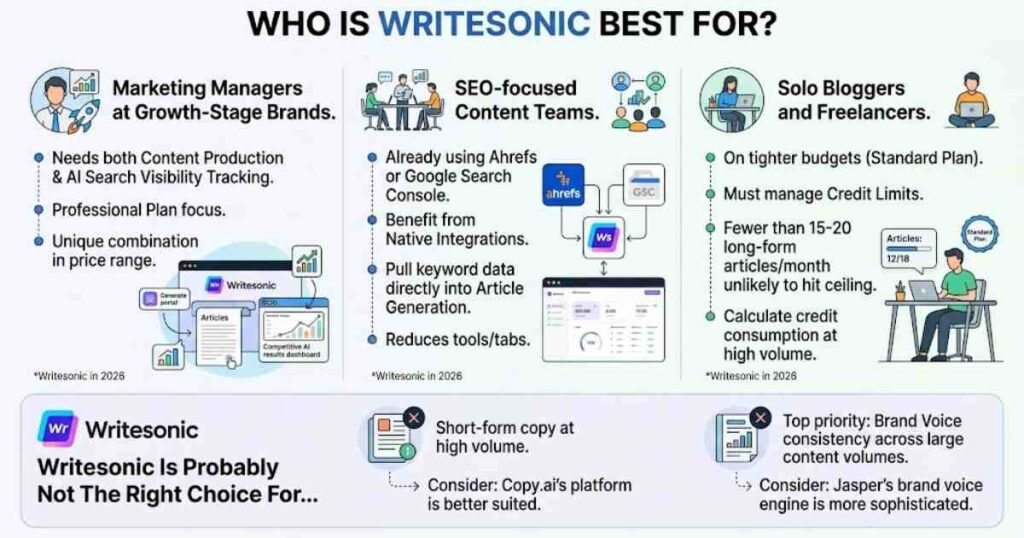
Marketing managers at growth-stage brands who need both content production and AI search visibility tracking will find the combination genuinely useful, particularly on the Professional plan. No other tool in this price range bundles both capabilities in a single platform.
SEO-focused content teams already using Ahrefs or Google Search Console will benefit most from the native integrations. The ability to pull keyword data directly into the article generation workflow reduces the number of tools and tabs involved in a typical content sprint.
Solo bloggers and freelancers on tighter budgets can make the Standard plan work, but should go in clear-eyed about credit limits. If you are producing fewer than 15 to 20 long-form articles per month, you are unlikely to hit the ceiling. Above that volume, calculate your expected credit consumption before committing annually.
Writesonic is probably not the right choice for teams that primarily need short-form copy at high volume (Copy.ai’s platform is better suited there) or for teams where brand voice consistency across large content volumes is the top priority (Jasper’s brand voice engine remains the most sophisticated for that specific requirement).
Writesonic vs Alternatives
Writesonic vs Copy.ai: Copy.ai has positioned itself as a GTM AI platform, embedding AI into sales and marketing revenue workflows rather than just content calendars. If your primary need is automating outbound sequences or lead nurture campaigns, Copy.ai is the stronger fit. For SEO-led long-form content production, Writesonic edges ahead. Full details in my Copy.ai review 2026.
Writesonic vs Notion AI: Notion AI enhances an existing workspace rather than functioning as a standalone content generator. If you already run your work in Notion, Notion AI is a natural extension. For dedicated AI writing with built-in SEO tools, Writesonic is the more capable standalone choice. See my Notion AI review for a full comparison of that platform.
Writesonic vs Jasper: Jasper remains the premium option for teams that need rigorous brand voice consistency across large content volumes. Its brand voice engine is the most sophisticated currently available at any price point. Writesonic costs significantly less and delivers comparable output quality for most general use cases, but cannot match Jasper’s brand governance capabilities for large, structured content teams.
For a broader overview of the market, the best free AI writing tools for students guide covers the budget end of the spectrum in detail.
Frequently Asked Questions About Writesonic
Is Writesonic free to use?
Yes. Writesonic offers a free plan with 25 credits per month and no credit card required. Access is limited to GPT-4o mini and Claude Haiku models with restricted generation volumes. It is functional for occasional light use but is not sufficient for regular content production at any meaningful scale.
What is the difference between Writesonic and Chatsonic?
Writesonic is the overall platform, encompassing the AI Article Writer, content templates, GEO tools, and all other features. Chatsonic is the conversational AI interface within Writesonic that allows you to interact with multiple AI models (GPT-4o, Claude Sonnet, and Gemini 1.5 Pro) in a single chat window without switching tools.
Has Writesonic changed its focus in 2026?
Significantly, yes. Writesonic has repositioned itself as a GEO and AI search visibility platform rather than primarily an AI writing tool. The writing features remain and have been improved with Article Writer 6.0, but the platform now places equal emphasis on tracking brand visibility across AI search engines like ChatGPT, Perplexity, and Google AI Overviews. This is a meaningful strategic shift that affects which plan tiers offer full value.
Is Writesonic good for SEO content?
Yes, Writesonic is one of the stronger AI writing tools for SEO-focused content. It includes native integrations with Ahrefs and Google Search Console (Standard plan and above), built-in keyword targeting in the Article Writer, real-time web research in Article Writer 6.0, and GEO tracking to monitor how content appears in AI search results. These capabilities make it more useful for SEO teams than most tools at a comparable price point.
Do Writesonic credits roll over each month?
No. Credits reset at the start of each billing cycle and do not accumulate. This is one of the platform’s most common user complaints in 2026 and is worth factoring into your plan selection. If your usage is variable month to month, you may end up wasting credits in lighter months with no ability to carry them forward.
Writesonic Review Verdict: Is It Worth It in 2026?
Writesonic in 2026 is a strong tool in an interesting transition period. The writing quality is genuinely good, Article Writer 6.0’s real-time research is a meaningful step forward, and the GEO visibility features are ahead of most competitors at this price point. The credit rollover limitation is a legitimate frustration, and the platform’s expanding scope makes it feel more complex than it did two years ago. If you need both AI content production and AI search visibility tracking in one platform, Writesonic is currently the best value option for that combination. As a focused writing tool only, it remains competitive at the Standard tier, though the interface now carries features you may never use.
This article was written by Alex Rivera for AI Genius Optimizer. Some links in this article are affiliate links. If you purchase through them, we may earn a commission at no extra cost to you. We only recommend tools we have personally tested and genuinely rate.