
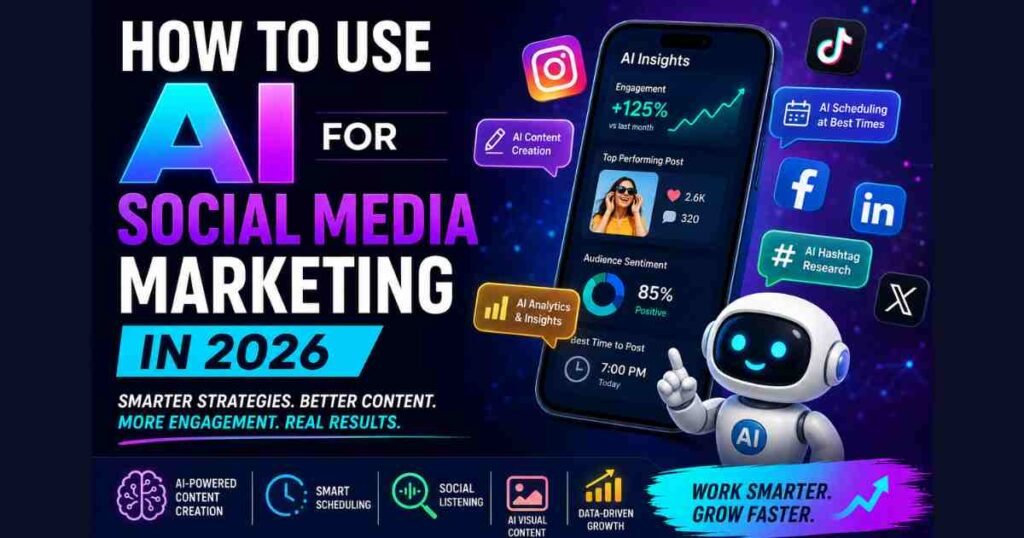
How to use AI for social media marketing is one of the most common questions I get from business owners right now, and I understand why. Managing multiple platforms, creating fresh content daily, tracking what is working, and staying on top of engagement is genuinely exhausting. Most small business owners do this on top of running their actual business. AI does not solve every problem, but used correctly, it removes the parts that drain the most time and delivers measurable returns on the effort you put in.
Why Using AI for Social Media Marketing Matters Right Now
The numbers tell a clear story. According to McKinsey, businesses that integrate AI into their marketing functions see up to 20% higher ROI. Separately, data from Sprout Social shows that brands using AI-powered social listening tools report a 25% improvement in engagement rates compared to those relying on manual monitoring alone.
The productivity shift is equally significant. Marketing teams that adopted AI content tools now produce an average of 4.1 times more published content per marketer each month than they did before adoption. That is not a marginal efficiency gain. It represents a structural change in what a small team can realistically output.
The tools themselves have matured quickly. Content creation, scheduling, hashtag research, audience analysis, visual content generation, and performance reporting can all be partially or fully handled by AI in 2026. The question is knowing where to start, and in which order.
How to Use AI for Social Media Marketing: A Step-by-Step Approach

Step 1: Start with Content Creation, Not Scheduling
Most business owners reach for a scheduling tool first. That is the wrong order. Start with content creation, because without a reliable stream of content, there is nothing worth scheduling.
Jasper AI is one of the strongest options for business owners who need platform-specific content at scale. The Pro plan is priced at $69 per month on monthly billing, or $59 per month billed annually (pricing verified June 2026). It includes Brand Voice training, which means the AI learns your tone and writes in it rather than generating generic copy. In my consulting work, I have seen businesses cut caption writing time from 45 minutes per post down to under ten minutes. The output still needs a human edit, but the first draft arrives in seconds.
For businesses on a tighter budget, Buffer’s built-in AI Assistant is included on all plans, including the free tier. It generates caption drafts and adjusts tone across platforms. Buffer’s paid plans start at $5 per channel per month, making it one of the most accessible entry points for small operations. You can read more about getting started with AI tools for your business in our guide to how to use AI for small business growth.
Step 2: Use AI Scheduling to Post at Peak Times
Once you have a content pipeline in place, AI scheduling tools remove the guesswork around timing. Platforms like Buffer and Later use historical engagement data from your specific account to recommend optimal posting windows, rather than relying on the generic “best times to post” advice that applies to no one in particular.
Later starts at $18.75 per month on annual billing (verified June 2026) and is particularly strong for visual-first brands running Instagram and TikTok, with grid planning tools that let you visualise how posts will look before they go live. Bear with me on this one, because it sounds obvious: posting at the right time is not enough if the content itself is weak. AI scheduling amplifies good content. It cannot rescue poor content from being ignored.
Step 3: Set Up AI Social Listening
This is the step most small businesses skip, and it is often where the biggest ROI hides. Social listening means monitoring conversations about your brand, your competitors, and your industry topics across social platforms, forums, and publications, without manually checking each one.
Tools like Sprout Social and Brandwatch use AI to aggregate these conversations and surface patterns in real time. You can identify what customers are actually saying before problems escalate publicly. You can spot trending topics in your niche before your competitors do. You can also track sentiment shifts after a product launch or a pricing change.
For businesses not yet ready to invest in a dedicated listening platform, Hootsuite’s Standard tier (starting at around $99 per user per month on annual billing, verified June 2026) includes AI-assisted analytics and basic social monitoring capabilities alongside scheduling.
Step 4: Apply AI to Visual Content Production
AI image generation has moved from novelty to practical business tool. Canva’s Magic Design feature can produce 50 variations of any post design in under 30 seconds. Jasper’s Business plan includes full image generation and editing, including background replacement and image upscaling, which is particularly useful for product-based businesses that need consistent visual branding without booking a photographer weekly.
The practical application here is not to replace your brand photography entirely, but to fill the content gaps between major shoots. Static promotional posts, quote graphics, educational carousel slides, and seasonal content can all be produced quickly with AI, keeping your feed active and consistent.
Step 5: Use AI Analytics to Guide Weekly Adjustments
The final step is treating AI analytics as a weekly habit rather than a monthly review. Most scheduling platforms now include AI-generated performance summaries that highlight which posts drove the strongest engagement, which content formats are underperforming, and what topics your audience consistently responds to.
As a business growth consultant at AI Genius Optimizer, I recommend blocking 20 to 30 minutes every Monday morning to review these summaries and adjust the content plan for the coming week. The businesses that see the strongest results are not the ones posting the most content they are the ones iterating the fastest based on what the data tells them.

Real-World Results You Can Expect
Setting realistic expectations is important. Here is what businesses typically experience in the first 90 days of implementing AI for social media:
Content volume increases substantially. Most businesses go from two or three posts per week to daily posting, without adding headcount. Output quality varies at first, but improves as AI tools learn your brand voice and you develop a sharper editing workflow.
Engagement rates improve gradually, then noticeably. The algorithm on every major platform rewards accounts that post regularly. AI is what makes consistent posting achievable for a small team. After 60 to 90 days of consistent, AI-assisted output, most businesses see meaningful improvements in reach and interaction.
Time savings are the most immediate result. I have worked with business owners who were spending eight to ten hours per week on social media. With a properly configured AI toolkit, that drops to two to three hours while actually increasing the volume and variety of content going out. If you are also looking to save time across other business functions, our guide to automating your business with AI covers the broader picture.
Common Mistakes to Avoid
Over-automating and losing your voice. Letting AI handle everything makes your social media feel mechanical and erodes audience trust over time. The strongest accounts in 2026 use AI to handle the heavy lifting and humans for the personal touches: replies, live content, and real community interaction. If every post sounds like it came from the same template, your audience will notice.
Skipping the brand voice setup. Tools like Jasper allow you to upload your existing content or style guide so the AI writes in your specific tone. Businesses that skip this step end up with copy that is technically correct but generically written. The setup takes an hour. It saves months of editing frustration.
Ignoring the data. AI analytics tools surface insights that would take hours to pull manually. If you are paying for a platform that includes performance reporting and not looking at it weekly, you are leaving the most actionable part of the tool unused. For a broader overview of which AI platforms deliver the most business value, our best AI tools for small business guide covers the top picks across categories.
Frequently Asked Questions About AI for Social Media Marketing
What is the best AI tool for social media marketing in 2026?
There is no single best tool because different businesses have different needs. For content creation and brand voice consistency, Jasper AI is the strongest option for businesses with established branding. For small businesses on a budget, Buffer with its built-in AI assistant provides solid entry-level functionality at $5 per channel per month. For Instagram and TikTok-first brands, Later’s visual planning tools and AI-optimised scheduling make it a practical choice.
How much does it cost to use AI for social media marketing?
Costs range widely depending on the tools you choose. Buffer’s paid plans start at $5 per channel per month. Later’s entry plan starts at $18.75 per month on annual billing. Jasper Pro is $59 per month billed annually or $69 per month on monthly billing. Hootsuite Standard is approximately $99 per user per month on annual billing. All pricing verified June 2026. Most platforms also offer free trials, which allows you to test before committing.
Can AI replace a social media manager?
Not fully, and not soon. AI handles content drafting, scheduling, basic performance analysis, and social listening well. It cannot build genuine community relationships, respond naturally to nuanced comments, make judgment calls on sensitive topics, or create the unscripted personality-driven content that builds real audience loyalty. AI is a tool that makes social media managers significantly more productive, not one that makes them redundant.
How long does it take to see results from AI social media tools?
Time savings are usually visible within the first two weeks of implementation. Improvements in engagement and reach typically become measurable after 60 to 90 days of consistent, AI-assisted posting. Consistency is the key driver here, and AI is precisely what makes consistency achievable for a business without a dedicated social team.
Is AI-generated social media content detectable?
Increasingly, yes. Platforms are developing detection systems, and audiences are also becoming more alert to content that sounds formulaic or lacks specific personality. This is why editing AI output for tone, specificity, and human voice is non-negotiable. Treat AI as a first-draft engine, not a publish-ready content machine, and the output quality will be significantly stronger.
Building Your AI Social Media System
If you are ready to stop managing social media reactively and start building a system that actually scales, AI tools are the most practical starting point. Begin with content creation to establish consistency, add scheduling to optimise timing, then layer in social listening and analytics over the following four to six weeks. The businesses seeing the strongest results are not necessarily using the most expensive tools they are the ones who built a clear process and stuck to it.
This article was written by Jordan Clarke for AI Genius Optimizer. Some links in this article are affiliate links. If you purchase through them, we may earn a commission at no extra cost to you. We only recommend tools we have personally tested and genuinely rate.