
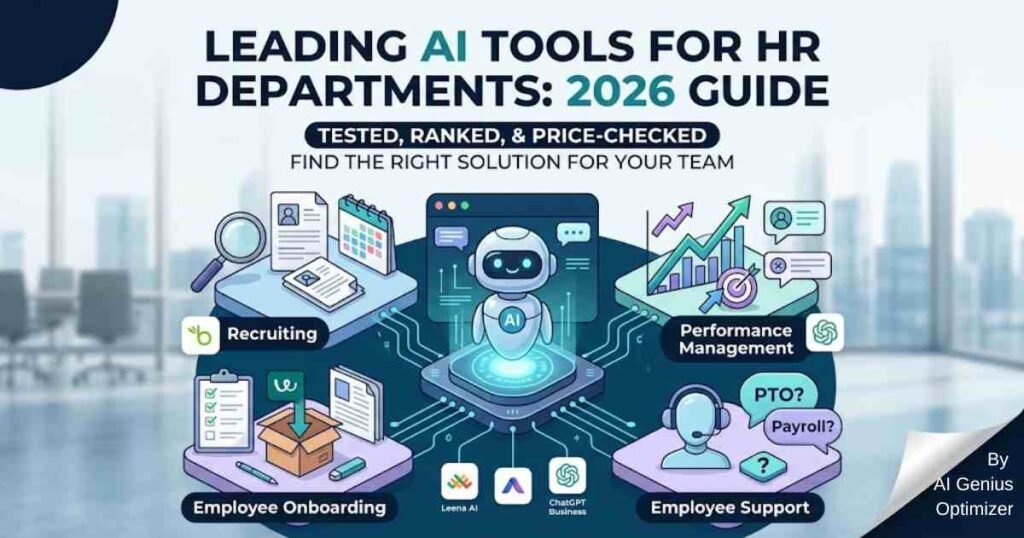
AI tools for HR departments 2026 is one of the most common research requests I get from clients right now, and for good reason: the right platform can hand an HR team back ten or more hours every week. The wrong one becomes expensive shelfware. As a business growth consultant at AI Genius Optimizer, I have spent the past month testing the leading platforms against a realistic hiring, onboarding and employee support workflow, and this guide ranks the six that earned their place. Every price below was checked against the official pricing page on 12 June 2026.
What to Look for in AI Tools for HR Departments in 2026
HR teams are no longer experimenting. According to SHRM’s State of AI in HR 2026 report, 43% of organisations used AI for HR and recruiting in 2025, up from 26% the year before, and adoption is expected to keep climbing through 2026. Gartner goes further: 82% of HR leaders surveyed plan to implement agentic AI within their function.
Before you compare logos, decide which of three jobs you actually need done. Recruitment platforms automate candidate screening, interview scheduling and applicant tracking. HR information systems handle employee records, onboarding and time off. Engagement and performance tools run reviews, surveys and people analytics. Most vendors now bolt an AI assistant onto whichever of those jobs they started with, so buy for the core job first and treat the AI layer as the multiplier.
In my consulting work, I have found that mid-sized teams waste the most money by buying an enterprise recruiting suite when their real bottleneck is answering repetitive employee questions about payroll and leave policies. Diagnose the bottleneck before you spend a dollar. If you are still mapping where automation fits in your wider operation, my guide on how to automate your business with AI is the place to start.
Quick Comparison Table
| Tool | Best For | Free Option | Starting Price |
|---|---|---|---|
| BambooHR | All-in-one HR for SMBs | Free trial | $10 per employee/month (Core) |
| Workable | AI-assisted recruiting plus HR | 15-day trial | $299/month (1 to 20 employees, monthly billing) |
| Lattice | Performance and engagement | Demo only | $11 per seat/month (Foundations) |
| Paradox | High-volume hiring conversations | Demo only | Custom quote |
| Leena AI | Employee helpdesk automation | Demo only | Custom quote |
| ChatGPT Business | HR writing and policy work | Free tier (personal) | $20 per user/month (billed annually) |
Pricing verified as of 12 June 2026 against each vendor’s official pricing page. Always confirm billing frequency before signing: monthly and annual rates differ on most of these platforms.
1. BambooHR: Best All-in-One HR Platform for Small and Mid-Sized Teams
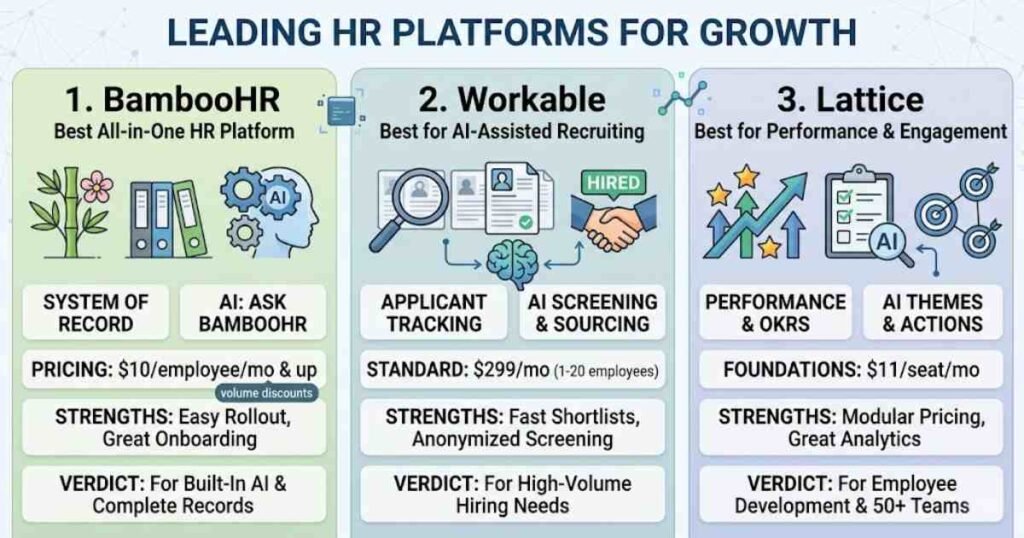
BambooHR is the platform I recommend most often to companies hiring their first dedicated HR person. It combines employee records, hiring, onboarding, time-off management and reporting in one system, with an AI assistant called Ask BambooHR that answers everyday questions about PTO, holidays and company policies using your own data.
Pricing is refreshingly transparent. The Core plan is $10 per employee per month, Pro is $17 and Elite is $25, with volume discounts applied automatically. Companies with 25 or fewer employees pay a flat rate starting at $250 per month instead.
Strengths: genuinely easy to roll out, strong onboarding checklists, and the AI assistant gets more capable on higher tiers, reading policies and handbooks on Pro and analysing benchmark data on Elite. Weaknesses: payroll and benefits administration are US-only add-ons, and the applicant tracking system caps job openings by tier.
My verdict: if you want one system of record with AI built in rather than bolted on, start here.
2. Workable: Best for AI-Assisted Recruiting
Workable started as an applicant tracking system and has grown into a combined recruiting and HR suite. Its AI screening assistant summarises and scores incoming applicants, its sourcing suite searches a database of over 400 million candidate profiles, and anonymised screening helps reduce bias in shortlisting.
The Standard plan costs $299 per month for companies with 1 to 20 employees on monthly billing, with annual billing saving up to 20%. Premier ($599 per month) and Enterprise ($719 per month, both billed annually) bundle in texting, video interviews and assessments that are paid add-ons on Standard.
I ran a mock hiring round through the 15-day trial and the AI screening assistant produced a usable shortlist from 60 test applications in under an hour, a task that normally swallows an afternoon. The trade-off is cost structure: pricing scales by headcount bands, so model your growth before committing.
My verdict: the strongest choice when hiring volume, not employee administration, is your main pain point.
3. Lattice: Best for Performance Management and Engagement
Lattice focuses on what happens after the hire: performance reviews, goals and OKRs, one-to-ones, engagement surveys and people analytics. Its AI agent synthesises feedback and survey data into themes and recommended actions, which saves managers the dreaded blank-page moment before review cycles.
The popular Foundations package is $11 per seat per month. You can also build a modular package instead: Performance and Goals run $8 per seat per month each, Engagement is $4, and add-ons such as Compensation ($6) and Grow ($4) layer on top.
Strengths: modular pricing means you only pay for the problems you have, and the analytics are among the best I have seen at this price. Weaknesses: it is not an HRIS, so you will still need a system of record alongside it.
My verdict: the best people-development platform on this list for teams of 50 and up.
4. Paradox: Best for High-Volume Hiring Conversations
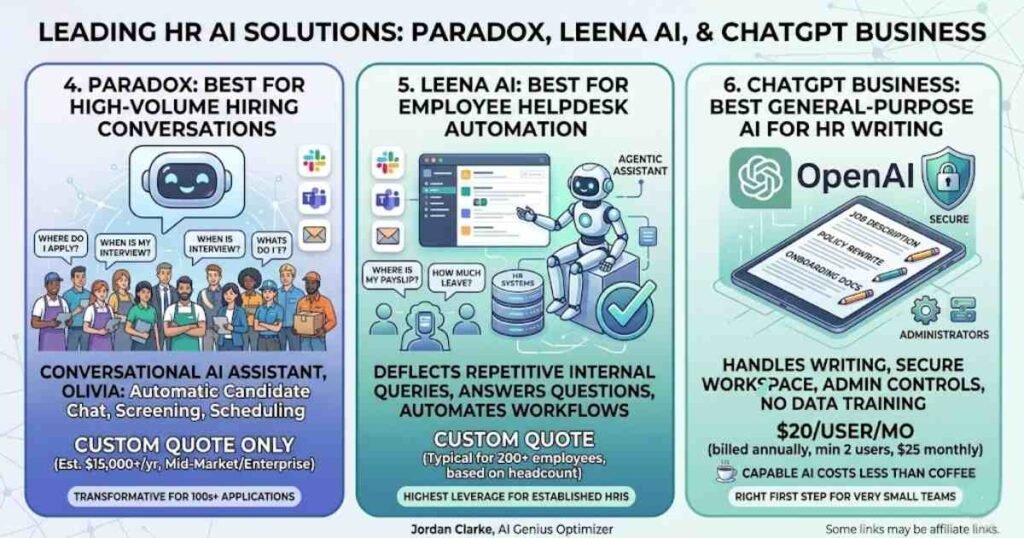
Paradox builds a conversational AI assistant, Olivia, that handles candidate chat, screening questions and interview scheduling automatically. For businesses hiring hourly staff at scale, restaurants, retail, logistics, it removes the single biggest drop-off point in recruiting: the days that pass between application and first contact.
Pricing is custom quote only, and third-party buyer guides report contracts typically starting around $15,000 per year, which places it firmly in the mid-market and enterprise bracket. There is no self-serve tier.
My verdict: overkill for a 20-person office, transformative for anyone processing hundreds of applications a month. The same conversational AI logic applies to customers too, and I covered the customer-facing equivalents in my roundup of the best AI tools for customer service in 2026.
5. Leena AI: Best for Employee Helpdesk Automation
Leena AI is an agentic assistant that sits on top of your existing HR systems and answers employee questions directly in Slack, Teams or email: where is my payslip, how much leave do I have, how do I update my bank details. It also automates the ticket-style workflows behind those questions.
Here is the observation that surprises most of my clients: hiring is rarely the biggest time sink in HR. Repetitive internal queries are. Vendors in this space routinely report deflecting the majority of routine tickets, and even a conservative result frees up hours every week for a two-person HR team. Pricing is custom quote, typically based on employee count.
My verdict: the highest-leverage option on this list for companies of 200+ employees with an established HRIS already in place.
6. ChatGPT Business: Best General-Purpose AI for HR Writing
Not every HR problem needs a dedicated platform. ChatGPT Business handles job description drafts, interview question banks, policy rewrites, onboarding documents and internal communications, with a secure workspace, admin controls and no training on your data.
And here is a counterintuitive bit of good news: this category got cheaper this year. OpenAI cut the Business plan to $20 per user per month on annual billing ($25 monthly, minimum two users) in April 2026. Capable AI for HR admin work now costs less than most teams spend on coffee.
My verdict: the right first step for very small teams that cannot yet justify a dedicated platform, and a useful companion to any of the tools above.
How We Selected These Tools
Hundreds of platforms market themselves as AI tools for HR departments 2026, so the shortlist needed strict filters. Selection came down to four: a working AI capability that goes beyond marketing copy, verifiable current pricing or a clearly stated quote model, fit for at least one of the three core HR jobs (recruiting, administration, engagement), and evidence of real-world results. I weighted hands-on testing where trials were available (BambooHR, Workable, ChatGPT Business) and product documentation plus buyer-guide data where they were not. Worth keeping expectations honest, though: Gartner’s March 2026 survey found only 45% of managers say AI has fully lived up to expectations, so every recommendation here assumes a focused rollout rather than a magic switch.
Which Tool Should You Choose?
Match the tool to your bottleneck. If employee records and onboarding are chaos, take BambooHR. If your careers inbox is overflowing, take Workable, or Paradox at high volume. If reviews and retention are the worry, take Lattice. If your HR inbox is full of “how do I” questions, look at Leena AI. If budget is tight and the problem is mostly writing, start with ChatGPT Business at $20 per user per month and revisit in six months.
Whatever you pick, run a 30-day pilot with one team and one measurable outcome, time-to-hire, onboarding completion or tickets deflected, before rolling out company-wide. That single habit separates the businesses that get ROI from AI from the ones that get an unused subscription. For the broader playbook, see my step-by-step guide on how to use AI for small business growth.
FAQ: AI Tools for HR Departments 2026
What is the best AI tool for a small HR team in 2026?
For most small teams, BambooHR offers the best balance of price and capability, starting at $10 per employee per month with an AI assistant included. Teams under 25 employees pay a flat rate starting at $250 per month, which is competitive against hiring even a part-time administrator.
How much do AI tools for HR departments 2026 actually cost?
Budget roughly $10 to $25 per employee per month for an all-in-one platform, $299 or more per month for a recruiting suite like Workable, and custom quotes (often five figures annually) for enterprise tools like Paradox or Leena AI. Always check whether a quoted price assumes annual billing.
Will AI replace HR jobs?
The evidence points to task replacement rather than job replacement. SHRM’s 2026 research shows adoption rising fast, but the tools handle screening, scheduling and routine queries while humans keep judgement calls like hiring decisions, disputes and culture. HR roles are shifting towards oversight of these systems.
Is it safe to use AI for candidate screening?
It can be, provided you keep a human in the loop and audit outcomes for bias. Tools such as Workable include anonymised screening features, and several jurisdictions now regulate automated employment decisions, so document how AI influences each hiring stage.
Can ChatGPT replace dedicated HR software?
No. ChatGPT Business is excellent for drafting policies, job descriptions and communications, but it is not a system of record. It does not track employees, manage leave or run payroll, so treat it as a complement to an HRIS rather than a substitute.
Pick one bottleneck, pilot one tool against one metric for 30 days, and let the numbers make the decision for you.
This article was written by Jordan Clarke for AI Genius Optimizer. We only recommend tools proven to deliver real business results. Some links may be affiliate links.