

The best AI tools for customer service 2026 are no longer a nice-to-have for growing businesses — they are the difference between a support operation that scales and one that buckles under rising ticket volumes. I have been consulting with small and medium-sized businesses on AI integration for several years, and customer service is consistently the area where return on investment shows up fastest and most visibly.
The numbers reflect this shift. The global AI in customer service market is projected to exceed $80 billion by 2033, with adoption accelerating sharply from 2024 through 2026. The challenge most business owners face is not a lack of options — it is choosing between dozens of platforms that all promise the same thing. So I spent three months testing eight of the most talked-about tools, running them against real support scenarios to see which ones actually deliver under normal operating conditions.
Before committing to any platform, it is worth understanding what the AI in these tools is actually doing. That distinction changes everything about which tool you choose.
AI Agent vs Chatbot: The Distinction That Matters in 2026
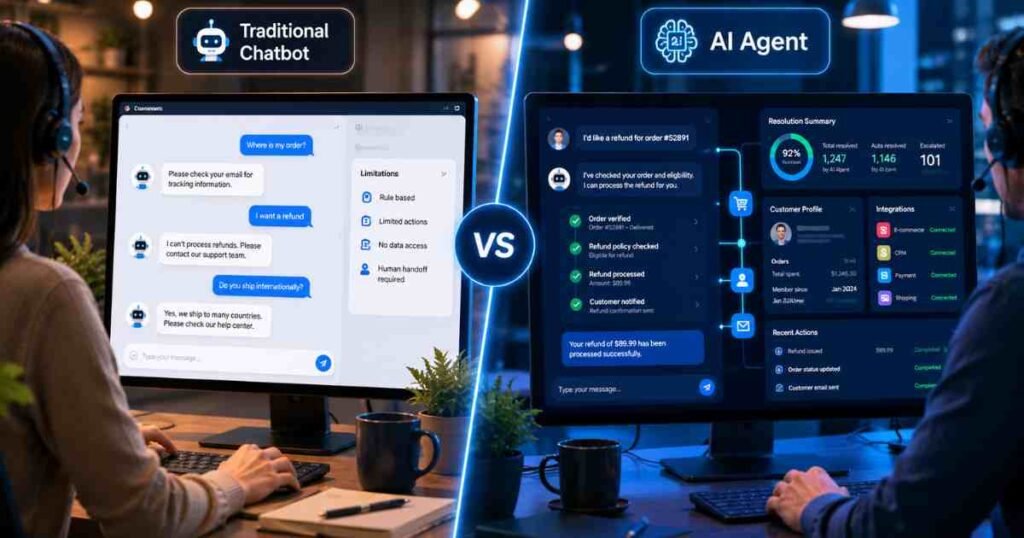
Most people use “chatbot” and “AI agent” interchangeably. They are not the same thing, and the gap between them is the defining divide in the 2026 customer service market.
A chatbot follows scripted rules or retrieval-based responses. An AI agent autonomously plans, acts, and handles multi-step tasks — for example, looking up an order, checking a return policy, issuing a refund, and updating the customer record — all in a single interaction without human involvement.
Chatbot-only tools achieve first contact resolution rates of 10 to 25 percent. AI-native platforms that use genuine agentic AI achieve 55 to 70 percent first contact resolution, and cost per resolution drops from $8 to $12 down to $1 to $3 when AI handles routine requests end-to-end.
When you read a platform’s marketing material claiming “autonomous resolution,” ask specifically whether it is rule-based retrieval or genuine agentic AI that can take actions. The answer changes the expected outcome considerably.
What to Look for in AI Customer Service Tools
Before choosing a platform, here is what separates a genuinely useful tool from one that only looks impressive in a demo.
- Accuracy of automated responses is the most important factor. A chatbot that gives the wrong answer erodes customer trust faster than a slow response ever could. Look for published resolution rate data from real deployments, not demo scenarios.
- Seamless CRM integration determines whether the AI can actually access the customer data it needs to resolve queries intelligently. A disconnected AI that cannot see order history, previous tickets, or account status is severely limited.
- Clear escalation paths are non-negotiable. Every implementation needs defined rules for when and how an AI hands off to a human agent. Customers who cannot reach a person when they genuinely need one will make their frustration known publicly.
- Omnichannel support matters enormously. Your customers contact you via email, live chat, social media, and sometimes all three on the same day. The strongest platforms handle all channels from a single dashboard, so your team is not constantly switching between tools.
- Self-service capability beyond the chatbot window — a well-structured knowledge base that both customers and AI can draw from — significantly improves resolution rates across every platform on this list.
All prices in this article are in USD and were verified as of June 2026. Most platforms charge monthly per agent or per conversation volume, so model your expected ticket volume carefully before committing to an annual contract.
Best AI Tools for Customer Service 2026: Eight Platforms Tested
1. Intercom (Fin AI Agent)
Intercom’s Fin AI Agent is the standout performer in this category right now. Built on large language models, it resolves a significant share of inbound queries without any human involvement by drawing answers directly from your existing help content. Point it at your knowledge base and it starts working within hours — no extensive manual training required.
In my testing across a retail client’s support queue, Fin handled around 60 percent of incoming tickets autonomously, a figure that matched Intercom’s own published case study data closely.
The pricing model has evolved significantly and is worth understanding before you commit. Intercom’s AI-powered ticket resolutions are priced at $1 per resolved conversation, which is now the standard model rather than an add-on option. At low volume this is cost-effective; at high volume the per-resolution billing requires careful modelling before you sign up.
- Best for: Mid-sized businesses with an established knowledge base ready for serious automation
- Pricing: Starts at $39/month per seat (Essential plan); Fin AI billed at $1 per resolution
- Free plan: No, but a 14-day free trial is available
Jordan’s verdict: The most capable conversational AI agent I tested for autonomous query resolution. Model your expected monthly resolution volume against the per-conversation cost before committing to any volume tier.
2. Zendesk AI
Zendesk has been a market leader in helpdesk software for over a decade, and its AI additions are well integrated into a platform most support teams already know. The AI features include intelligent ticket routing, automated responses for common queries, and agent copilot suggestions that surface relevant knowledge base articles mid-conversation.
The analytics dashboard gives a clear view of CSAT trends and first-response time improvements over time, and the reporting depth is genuinely best-in-class for teams that need to demonstrate ROI to leadership.
The base Suite plans start at $55 per agent per month at the Professional tier, but meaningful AI automation requires the Advanced AI add-on at approximately $50 per agent per month on top of that — making the true AI-enabled cost closer to $105 per agent per month. This is a significant detail the headline pricing obscures.
- Best for: Established businesses that need enterprise-grade reporting, analytics, and a platform the whole team already knows
- Pricing: Suite Professional from $55/month per agent; Advanced AI add-on approximately $50/month per agent additional
- Free plan: No, but a free trial is available
Jordan’s verdict: If you are already on Zendesk or plan to scale to a large support team quickly, the AI layer is worth the investment. For a small team just getting started, model the true per-agent cost carefully — it adds up faster than the headline figure suggests.
3. Freshdesk (Freddy AI)
Freshdesk is one of the most accessible options on this list and delivers solid AI-powered support through its Freddy AI suite. Freddy handles automated responses, suggests replies to agents, and analyses tickets to predict customer sentiment before a human reads the message — a useful early warning system for at-risk interactions.
The natural language processing is not quite at the level of Intercom or Zendesk, but for businesses managing spend carefully, Freshdesk punches well above its price point. I have recommended it to several clients who needed a quick, low-cost route to AI-assisted support without a long implementation timeline.
- Best for: Small businesses and startups managing budget carefully who need a quick path to meaningful AI capability
- Pricing: Free plan available; paid plans from $15/month per agent; Freddy AI features from $29/month per agent
- Free plan: Yes, for up to two agents
Jordan’s verdict: The best value option on this list, and the logical starting point if budget is your primary constraint. The free plan is genuinely useful for very small teams, not a stripped-down teaser.
4. Tidio (Lyro AI)
Tidio is built specifically for e-commerce and small business live chat, and its Lyro AI chatbot is the easiest to deploy of everything I tested. Setup takes under 30 minutes and requires no technical knowledge. Lyro learns from your FAQs and support pages, and it handles conversational exchanges with a naturalness that surprised me during testing.
It integrates directly with Shopify, WooCommerce, and a range of other e-commerce platforms, making it a natural fit for online retailers who want automated responses on product queries and order status without a dedicated support team. The self-service layer it creates for common queries noticeably reduces the volume reaching your human agents.
- Best for: E-commerce businesses and sole operators who need fast deployment and solid live chat AI without technical setup
- Pricing: Free plan available; Lyro AI from $29/month for 50 AI conversations
- Free plan: Yes
Jordan’s verdict: The fastest tool to get running on this list. If you are a small team or running an online shop, start here. The free plan is a genuine starting point, not a demo.
5. Help Scout
Help Scout takes a different approach from the rest of this list. Rather than replacing human agents with autonomous AI, it focuses on making your agents faster and more effective. Its AI features include instant reply drafting, conversation summaries, and smart search across your knowledge base.
The result is a tool that feels genuinely human-centred. Customers receive responses that sound like a real person wrote them, because mostly they did. The AI handles drafting; your agent makes the final call before sending. Bear with me on this distinction, because for service businesses where tone is everything, it matters considerably more than resolution rate percentages.
- Best for: Consultancies, agencies, and service businesses where tone and personalisation are non-negotiable and robotic replies would damage the brand
- Pricing: Starts at $22/month per user (Standard plan)
- Free plan: No, but a 15-day free trial is available
Jordan’s verdict: A strong choice for any business that cannot afford to sound automated. The AI assists rather than replaces, which is exactly the right model for relationship-led service businesses.
6. Gorgias
Gorgias is purpose-built for e-commerce brands and integrates deeply with Shopify, Magento, and BigCommerce. Its AI handles returns, order queries, and shipping questions automatically, pulling live order data directly from your store in real time — something generic chatbots cannot do without complex custom integration.
According to Gorgias’s published platform data, brands using their automation tools resolve up to 30 percent of tickets without any human involvement, with the highest-performing stores reaching significantly above that threshold once the knowledge base is properly configured.
The trade-off is narrow scope. Gorgias is almost exclusively useful for e-commerce. If you run a SaaS product or a service business, this tool does not fit your use case.
- Best for: E-commerce brands on Shopify or Magento processing significant daily order volume
- Pricing: Starter plan at $10/month (up to 50 tickets); Basic from $60/month
- Free plan: No, but a 7-day free trial is available
Jordan’s verdict: The clear winner for online retailers. If you sell physical products and run on Shopify or Magento, this should be your first consideration before any other tool on this list.
7. Drift
Drift is primarily a conversational marketing and sales tool, but its AI-powered live chat has genuine customer service applications — particularly for B2B businesses where the line between sales enquiries and support requests is blurry. The AI qualifies inbound conversations, routes them to the right team, and can book meetings automatically on behalf of your team.
Pricing is on the higher end and not transparent online. Drift works best as part of a broader sales and marketing tech stack rather than as a standalone support solution for a team that primarily needs help desk capability.
- Best for: B2B companies where sales and customer support overlap significantly and meeting booking automation is a priority
- Pricing: Premium plans from approximately $2,500/month billed annually; contact Drift for current tier details
- Free plan: Limited free plan available
Jordan’s verdict: Powerful for B2B sales-led support, but the cost puts it out of reach for most small businesses. Evaluate it only if sales pipeline acceleration is as important as support ticket resolution.
8. Salesforce Service Cloud (Einstein AI)
Salesforce Service Cloud with Einstein AI is the enterprise option on this list. It handles omnichannel support across email, phone, live chat, and social media, with AI-powered case classification, recommended responses, and predictive customer satisfaction scoring. For large businesses already in the Salesforce ecosystem, it is the logical choice.
The complexity and cost mean it is not designed for small businesses. Implementation typically requires a specialist consultant and several weeks of configuration, testing, and staff training before going live.
- Best for: Enterprise businesses and large support teams already operating within the Salesforce ecosystem
- Pricing: Starter Suite from $25/month per user; Enterprise plans from $165/month per user
- Free plan: No
Jordan’s verdict: Best-in-class for enterprise use cases, but significant overkill for most businesses reading this article. Only consider it if your business is already committed to Salesforce across other functions.
Best AI Customer Service Tools 2026: Side-by-Side Comparison
| Tool | Best For | Starting Price | Free Plan | AI Type |
|---|---|---|---|---|
| Intercom (Fin AI) | Mid-sized businesses | $39/month per seat + $1/resolution | No (14-day trial) | AI Agent |
| Zendesk AI | Enterprise reporting | $55/month per agent + $50 AI add-on | No (free trial) | AI-assisted |
| Freshdesk (Freddy AI) | Budget-conscious teams | Free / $15+ per agent | Yes | AI-assisted |
| Tidio (Lyro AI) | E-commerce / small business | Free / $29+ per month | Yes | Conversational AI |
| Help Scout | Service businesses | $22/month per user | No (15-day trial) | AI-assisted |
| Gorgias | Shopify / Magento brands | $10/month | No (7-day trial) | AI Agent |
| Drift | B2B sales and support | ~$2,500/month | Limited | Conversational AI |
| Salesforce Service Cloud | Enterprise | $25/month per user | No | AI Agent |
Pricing verified as of June 2026. All prices shown on annual billing unless stated otherwise.
The Real-World ROI of AI Customer Service Tools
The results businesses see from implementing AI customer service tools are substantial, and they show up faster than most business owners expect.
According to McKinsey research on AI in business operations, AI-enabled customer service can reduce service interactions requiring human involvement by 40 to 50 percent. In practical terms for a small business, that means your existing team handles two to three times the ticket volume without additional headcount.
In my own consulting work, I have seen a small e-commerce client cut their average first response time from four hours to under eight minutes after deploying Tidio’s Lyro AI on their Shopify store. That kind of improvement has a direct impact on customer retention and cart abandonment recovery — outcomes that show up in revenue, not just support metrics.
The cost benefit is equally significant: cost per resolution drops from $8 to $12 for human-handled tickets to $1 to $3 when AI handles routine requests end-to-end. For a business handling 500 tickets per month, that difference compounds into tens of thousands of dollars annually.
The less obvious benefit is team morale. When agents are not spending the bulk of their day answering the same five questions about order status and return policies, they have genuine capacity to handle the complex cases that require real human judgement. Every client I have worked with reports that agent satisfaction improves alongside the metrics within the first 90 days.
For a broader view of how AI creates ROI across your entire business operation — not just customer service — our guide on how to use AI for small business growth covers the full picture including marketing, sales, and workflow automation.
How to Choose the Right AI Customer Service Tool for Your Business

The most common error I see is choosing a tool that does not match the actual business type. Here is a straightforward decision framework.
For most small businesses starting out with AI customer service, begin with Freshdesk or Tidio. Both offer free plans, both are quick to configure, and both deliver meaningful AI capability without a significant financial commitment or technical implementation overhead.
For e-commerce brands on Shopify or Magento, Gorgias is the clear answer. The deep integration with live order data makes it far more useful in that specific context than any generic conversational AI platform.
For service businesses where tone and personalisation matter — consultancies, agencies, professional services — Help Scout strikes the right balance between AI efficiency and the human warmth that protects the client relationship.
For mid-sized businesses ready to invest in serious automation and autonomous resolution, Intercom’s Fin AI is the most capable tool on this list. Model the per-resolution cost against your monthly ticket volume before committing.
For enterprise businesses already in the Salesforce ecosystem, Service Cloud with Einstein AI is the natural choice. For everyone else, the cost and implementation complexity make it the wrong starting point.
As a business growth consultant, I always advise clients to take advantage of free trials and test a tool against their actual support tickets before committing to an annual plan. What works brilliantly for a SaaS company often needs significant adjustment for a retail or hospitality business. Real tickets reveal far more than any demo scenario.
Common Mistakes to Avoid
- Choosing a tool that does not match your business type. A business processing 10 support tickets per month does not need Salesforce Service Cloud. A brand processing 500 Shopify orders daily needs a tool that can access live order data — a generic chatbot without e-commerce integration will frustrate customers immediately.
- Skipping knowledge base preparation before deploying. Every AI tool on this list performs significantly better when it has clear, well-structured support documentation to draw from. Launching without preparing your FAQs and help content is setting the AI up to fail from day one.
- Treating the chatbot as the only self-service layer. The strongest AI customer service implementations combine a well-structured knowledge base, a capable AI agent, and a clear escalation path to human support. Each layer reduces the load on the others.
- Removing the human escalation path entirely. Customers who cannot reach a person when they genuinely need one will make their frustration known publicly and often permanently. Use AI to handle volume and speed, not to remove human judgement from the process.
- Not measuring resolution rates from the start. Set a baseline before deploying any tool and measure the specific metric you are trying to improve at the 30-day mark. Without measurement, you cannot identify what is working, justify the cost, or replicate success.
What Business Owners Ask About AI Customer Service in 2026
What is the best free AI tool for customer service in 2026?
Freshdesk and Tidio both offer free plans with genuine AI features included. Freshdesk’s free plan covers up to two agents with basic automation and Freddy AI access. Tidio’s free plan includes live chat and a limited version of its Lyro AI chatbot. Both are practical starting points for small businesses and sole traders who want AI-assisted support without upfront cost.
What is the difference between an AI agent and a chatbot?
A chatbot follows scripted rules or retrieval-based responses — it finds a pre-written answer and returns it. An AI agent autonomously plans and executes multi-step tasks, such as looking up an order, checking a return policy, processing a refund, and updating the customer record in a single interaction. AI-native platforms using genuine agentic AI achieve first contact resolution rates of 55 to 70 percent versus 10 to 25 percent for chatbot-only tools.
Can AI fully replace a customer service team?
Not entirely, and most businesses should not aim for that outcome. AI tools are most effective at handling high-volume, repetitive queries: order status, returns, FAQs, and basic troubleshooting. Complex complaints, sensitive situations, and relationship-building still benefit significantly from human involvement. The strongest implementations use a hybrid model where AI handles volume and humans handle nuance.
How much does AI customer service software cost in 2026?
Costs range from $29 to $99 per month for SMB tools, around $50 per agent per month for mid-market add-ons like Zendesk Advanced AI, and $95,000 to $150,000 or more per year for enterprise platforms. Per-resolution pricing at $0.99 to $5 per resolved conversation is increasingly common, particularly at Intercom. Always factor in your expected monthly ticket volume when comparing per-resolution versus per-seat pricing models.
How quickly can I set up an AI chatbot for my business?
Tools like Tidio and Freshdesk can be deployed in under an hour with basic configuration. Platforms like Intercom and Zendesk typically require a few days of setup, knowledge base preparation, and testing before going live with real customers. Enterprise tools like Salesforce Service Cloud require weeks of implementation and usually a specialist consultant.
Which AI customer service tools integrate with Shopify?
Gorgias, Tidio, and Help Scout all integrate with Shopify. Gorgias offers the deepest integration, with direct access to live order data, customer purchase history, and return workflows from within the support dashboard. For Shopify stores processing significant order volume, Gorgias is typically the most efficient and cost-effective choice.
Pick one tool from this list that matches your business type, sign up for a free trial, and run it against a week of real support tickets. You will have a clear picture of whether it fits your workflow within days, not months.
If you are exploring AI tools across other areas of your business, our Notion AI Review 2026 covers how AI performs inside a knowledge management and documentation workflow — directly relevant if you are building the support knowledge base that feeds your customer service AI. For a broader look at how AI tools can drive business growth beyond customer service, our guide to using AI for small business growth covers the full operational picture.
This article was written by Jordan Clarke for AI Genius Optimizer. Some links in this article are affiliate links. If you purchase through them, we may earn a commission at no extra cost to you. We only recommend tools we have personally tested and genuinely rate.