
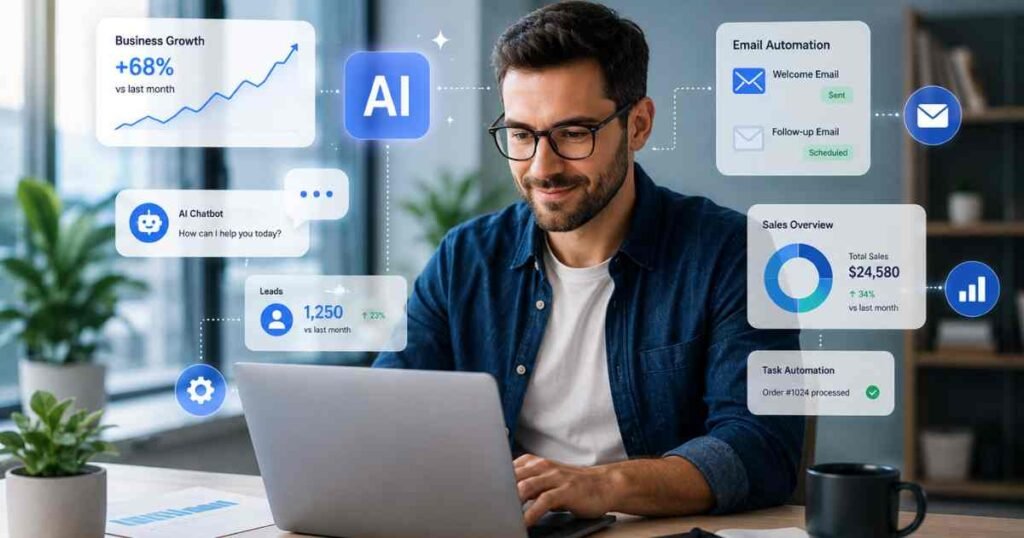
how to use AI for small business growth is no longer a future strategy — it is what separates businesses that scale in 2026 from those that stay stuck. Over two-thirds of small businesses in the US now use AI regularly to automate tasks, improve customer service, and sharpen their marketing, according to recent data compiled from the US Chamber of Commerce and Salesforce SMB surveys. A year ago, that figure was closer to 40 percent. The shift is happening fast.
I have spent several years helping small and medium businesses integrate AI into their daily operations as a business growth consultant at AI Genius Optimizer, and the pattern I see repeatedly is consistent. Businesses that adopt AI strategically reduce operational costs, improve customer experience, and free up hours every week to focus on the work that actually moves the needle. Businesses that ignore it are finding the competitive gap widens faster than they expect.
This guide walks you through exactly what to prioritise, which tools are worth your time, and how to build your first automated workflow without needing any technical background.
Why Using AI for Small Business Growth Matters Right Now
The barrier to entry has collapsed. AI tools that once required a dedicated development team and a significant budget now arrive as affordable monthly subscriptions, and many are free to start.
Small business AI usage jumped from 40 to 58 percent in a single year according to the US Chamber of Commerce, and 91 percent of small businesses using AI report revenue increases according to Salesforce. Those are not marginal gains — they represent a structural shift in how small businesses compete.
According to HubSpot’s 2026 State of Marketing report, 32.82 percent of marketing teams say AI tools are saving them 10 to 14 hours per week, and 67 percent report saving 10 or more hours weekly overall. At a conservative $25 per hour, even the lower end of that range translates to over $13,000 in reclaimed time annually — for a single team member.
Most small business owners I work with are not short of ambition. They are short of time. Generative AI and intelligent automation solve a time problem before they solve anything else — and time, for a small business owner, is the scarcest resource of all.
How to Identify AI Opportunities in Your Small Business
Before choosing any tool, map out where your hours are actually going. Most small businesses lose significant time in three areas, and these are the highest-ROI places to start your AI implementation.
Repetitive Customer Communication
How much time does your team spend answering the same questions every day? AI chatbots like Tidio or Intercom can handle 60 to 80 percent of routine customer queries automatically, responding instantly, 24 hours a day, without adding headcount. I helped a small e-commerce business in Manchester set one up in a single afternoon, and they reduced their support ticket volume by 40 percent within three weeks.
For local businesses in particular, AI chatbots on your website or Google Business Profile handle after-hours enquiries, appointment bookings, and FAQ responses at a scale no small team can match manually.
Content and Marketing Copy
Writing product descriptions, social media posts, email campaigns, and blog content is time-consuming and mentally draining. Generative AI tools like ChatGPT, Gemini AI, Jasper, or Copy.ai produce solid first drafts in minutes. The key is treating AI output as a starting point, not a finished product. Your role becomes editing and refining rather than starting from a blank page every time.
Administrative Workflows
Scheduling, data entry, invoicing follow-ups, and internal reporting are ideal candidates for automation. Zapier and Make (formerly Integromat) connect your existing apps and automate repetitive workflows without any coding knowledge required. Set them up once, and they run in the background indefinitely. This is where the concept of scalability becomes real for a small business: your output grows without your workload growing proportionally.
Best AI Tools for Small Business in 2026
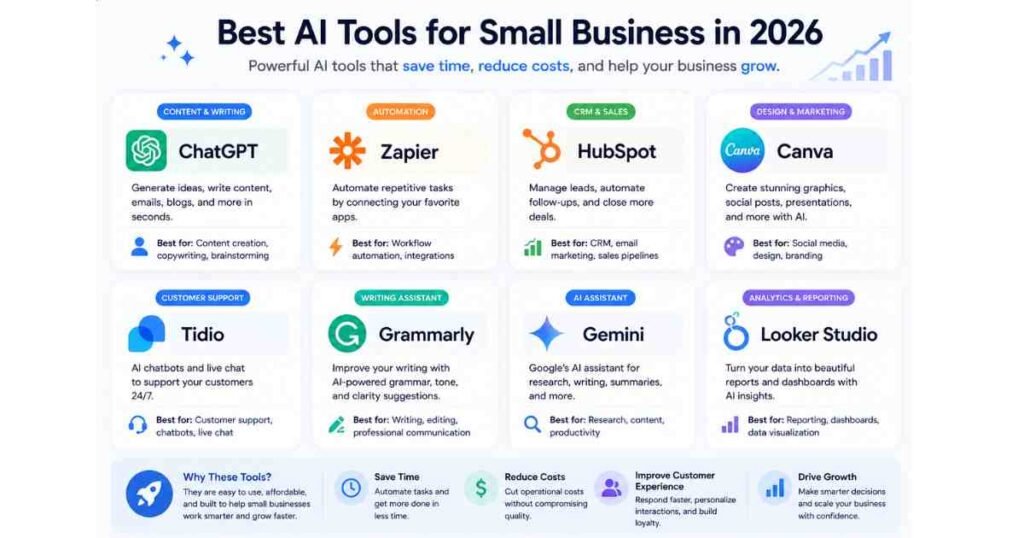
Not every AI tool is built for every business. Here is a practical breakdown organised by function, covering the tools that deliver consistent results for small businesses without requiring a technical background.
| Function | Tool | Best For | Free Tier? |
|---|---|---|---|
| Writing and content | ChatGPT | Drafting, brainstorming, emails | Yes |
| Writing and content | Jasper | Marketing copy, brand voice | Trial only |
| Customer service | Tidio | Website chatbot, live chat | Yes |
| Customer service | Intercom | Customer support automation | No |
| Workflow automation | Zapier | Connecting apps, automating tasks | Yes |
| Workflow automation | Make | Complex multi-step workflows | Yes |
| CRM and sales | HubSpot | Lead tracking, email sequences | Yes |
| CRM and sales | Zoho CRM | SMB sales pipeline, AI scoring | Yes |
| Marketing automation | ActiveCampaign | Email nurture, segmentation | No |
| Ad creative | AdCreative.ai | Social and display ad images | Trial only |
| Data and analytics | Google Looker Studio | Data visualisation, reporting | Yes |
| Local SEO | BrightLocal | Local search visibility | Trial only |
| Meeting notes | Otter.ai | Transcription, meeting summaries | Yes |
The rule I follow with every client is straightforward: start with the area costing you the most time, and fix that one thing first. Trying to implement five tools at once almost always results in none of them being used properly.
For a detailed look at how Perplexity performs in practice, our Perplexity AI Review 2026 covers three weeks of hands-on testing with real business use cases.
How to Build Your First AI-Automated Workflow
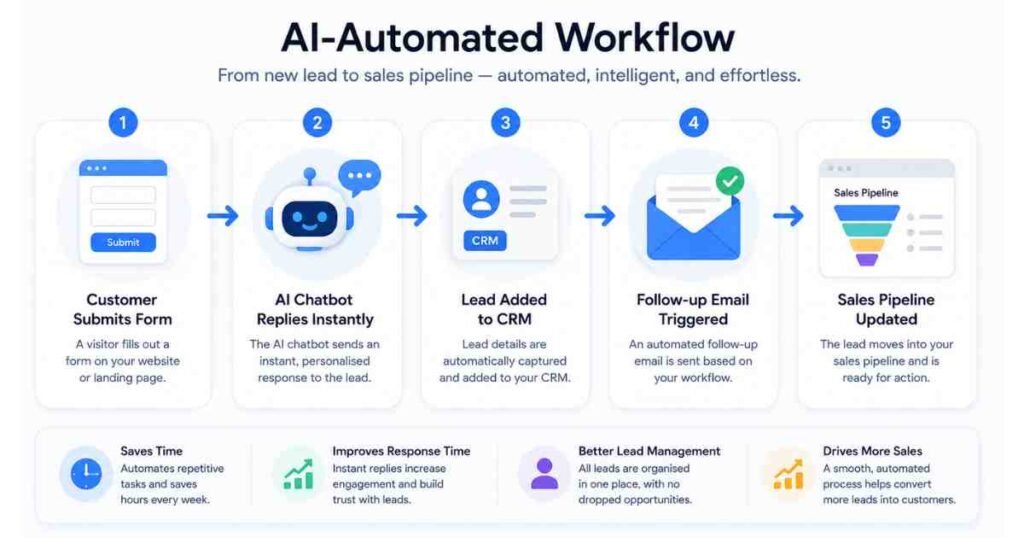
A workflow is a sequence of tasks that runs automatically without human input. Here is a practical example of what a basic lead-handling workflow looks like once set up.
A customer fills in a contact form on your website. Your AI chatbot sends an instant personalised acknowledgement. The lead is automatically added to your CRM with their details and enquiry type. A follow-up email is triggered 24 hours later, personalised with their name and the service they asked about. If they do not reply, a second follow-up goes out three days later.
Without automation, this sequence requires someone to monitor the inbox, manually transfer data, and remember every follow-up at the right time. With Zapier connecting your form, CRM, and email platform, the entire process runs without manual input and scales with your volume.
Setting this up typically takes two to three hours the first time. After that, it runs indefinitely.
AI for Small Business Marketing
Marketing is where generative AI delivers some of its most visible ROI for small businesses, because content creation is both essential and time-intensive.
AI for Social Media and Content Creation
Tools like ChatGPT, Jasper, and Copy.ai generate social media captions, blog post outlines, email newsletters, and ad copy in minutes. The workflow that works best for most small businesses is to use AI to produce a first draft, then edit it to match your brand voice and add specific details no AI would know — a customer story, a local reference, a product nuance.
For ad creative specifically, platforms like AdCreative.ai use machine learning to generate and test visual ad content at a speed and volume that would be impossible manually.
AI for Email Marketing
Email remains one of the highest-ROI marketing channels for small businesses, and AI improves every stage of it. ActiveCampaign and HubSpot both use AI to optimise send times, personalise subject lines, segment your audience based on behaviour, and trigger automated sequences based on what contacts actually do. The result is that your emails reach the right person at the right time with a message relevant to where they are in the customer journey — without you having to manage it manually.
AI for Local Business Marketing
Local businesses have a specific set of AI use cases that national brands do not need to worry about. AI tools can audit your existing online presence, flag inconsistent name, address, and phone data across directories, generate optimised Google Business Profile posts on a consistent schedule, and draft responses to customer reviews that sound human and brand-appropriate.
Tools like BrightLocal and Localo are built specifically for this. Managing your local SEO presence manually across multiple directories is genuinely time-consuming. Automating it with AI is one of the highest-leverage moves a local small business can make.
AI for Sales and Lead Generation
This is the area where small businesses often underestimate what AI can do, because most people think of AI as a content or customer service tool rather than a sales tool. In practice, AI-powered sales tools can significantly shorten your sales cycle and improve conversion rates.
AI-Powered CRM and Lead Scoring
Zoho CRM’s AI assistant, Zia, offers predictive sales analytics, helping teams understand which leads are most likely to convert, and performs sentiment analysis on customer communications. HubSpot’s free CRM does something similar at a simpler level, automatically scoring and prioritising leads based on their behaviour.
For most small businesses, the practical benefit is straightforward: instead of treating every lead equally, your team focuses their limited time on the contacts most likely to become customers. That alone improves close rates without increasing the number of leads in your pipeline.
Automated Follow-Up and Outreach
The majority of sales are lost not because a prospect said no, but because follow-up was inconsistent or too slow. AI tools integrated with your CRM can trigger personalised follow-up emails automatically based on where a lead is in your pipeline, whether they opened your last email, or how long it has been since they last engaged.
HubSpot’s free tier handles this well for small businesses. Apollo.io is worth exploring if you need outbound prospecting capabilities alongside your follow-up automation.
Using AI for Smarter Business Decisions
One of the most underused applications of AI for small businesses is decision support through data analytics. Most businesses already collect useful data through sales records, website traffic, and customer behaviour — but very few use it to make decisions.
Free tools like Google Looker Studio pull your existing data together and surface patterns that would take hours to find manually. The questions worth asking are specific: Which products have the highest return rate? Which marketing channel brings in customers with the highest lifetime value? Which day of the week sees the most abandoned checkouts?
Natural language processing tools built into platforms like HubSpot and Zoho can also analyse customer feedback and support conversations, identifying trends in complaints or requests before they become bigger problems. This is the kind of data-driven decision making that used to require a dedicated analyst. Now it is built into tools with a free tier.
Real-World ROI: What AI Implementation Actually Delivers
An analysis of 200 AI projects conducted between 2022 and 2025 found a median ROI of 159 percent for small and medium businesses, with payback reached in just 6.7 months on average.
Based on my consulting work with small businesses across various sectors, here is what a structured AI implementation typically delivers within 90 days.
Most businesses save between five and ten hours per week on content creation and customer communication tasks. Customer service response times drop by 20 to 40 percent. Email open rates improve by 15 to 25 percent when AI tools are used to optimise subject lines and send timing. Sales cycles shorten because follow-up is automated and consistent rather than dependent on someone remembering to send an email.
These are not extraordinary outcomes. They are what happens reliably when you apply the right tools to the right problems and measure the results.
Common Mistakes to Avoid
Trying to automate everything at once. Pick one bottleneck, fix it, measure it, and then move to the next. The businesses that get the best results start narrow and expand deliberately.
Choosing tools based on hype rather than fit. The most talked-about AI tool is not necessarily the right one for your operation. Match the tool to the problem, not the other way around. A content tool will not fix a customer service problem.
Skipping the testing phase. Before you let an AI chatbot respond to customers unsupervised, test every common scenario and check that the responses reflect your brand voice. A poorly configured chatbot damages trust quickly.
Neglecting the human element. AI handles volume and repetition well. Complex complaints, sensitive conversations, and relationship-building still need a human. Set clear escalation rules so customers are never left stuck in an automated loop.
Not measuring ROI. Set a baseline before implementing any tool, and measure the specific metric you are trying to improve at the 30-day mark. Without measurement, you cannot identify what is working or justify the cost.
Ignoring digital transformation at the infrastructure level. AI integration works best when your underlying data is clean and your systems are connected. Businesses with siloed tools and inconsistent data get far less value from AI than those with a coherent tech stack.
FAQ: How to Use AI for Small Business Growth
What is the best AI tool for a small business just getting started?
ChatGPT is the most accessible starting point for the majority of small businesses. It handles content drafting, email writing, brainstorming, customer communication templates, and research tasks with no technical setup required. Once you are comfortable there, explore more specialised tools based on your biggest remaining bottleneck.
Can AI replace employees in a small business?
Not in any meaningful sense for the foreseeable future. AI handles repetitive, high-volume tasks well: answering common customer questions, drafting first-pass content, processing data, and automating workflows. Complex judgement, relationship management, and creative strategy still require human input. Think of AI as a tool that handles the tasks that eat your team’s time, freeing them to do the work only humans can do.
How much does it cost to implement AI in a small business?
You can start with free tiers on tools like ChatGPT, Tidio, Zapier, and HubSpot. A practical starting toolkit with paid plans typically costs between $50 and $150 per month depending on the tools and usage levels. For most small businesses, the time saved pays for the cost within the first month.
Do I need technical skills to use AI tools?
No. The vast majority of AI tools designed for small businesses are no-code or low-code solutions. If you can use a spreadsheet, you can use most of them without any developer support.
How long does it take to see results from AI implementation?
Most businesses see measurable time savings within the first two to four weeks of deploying a single tool correctly. Broader results like revenue growth and improved conversion rates typically become visible over three to six months as automated workflows compound.
Which types of small businesses benefit most from AI?
Every business type benefits, but the use cases differ. Service businesses see the strongest early results from AI scheduling, customer communication, and proposal writing. E-commerce businesses benefit most from product description generation, inventory forecasting, and personalised recommendations. Local businesses get outsized value from AI local SEO tools and automated review management. Professional services firms save the most time on document analysis, email drafting, and meeting transcription.
AI adoption for small businesses is not slowing down, and the gap between businesses that use it well and those that do not is widening every quarter. Start with one workflow, measure the result, and build from there. The compounding effect on your business growth becomes visible faster than most people expect.
This article was written by Jordan Clarke for AI Genius Optimizer. We only recommend tools proven to deliver real business results. Some links may be affiliate links.