
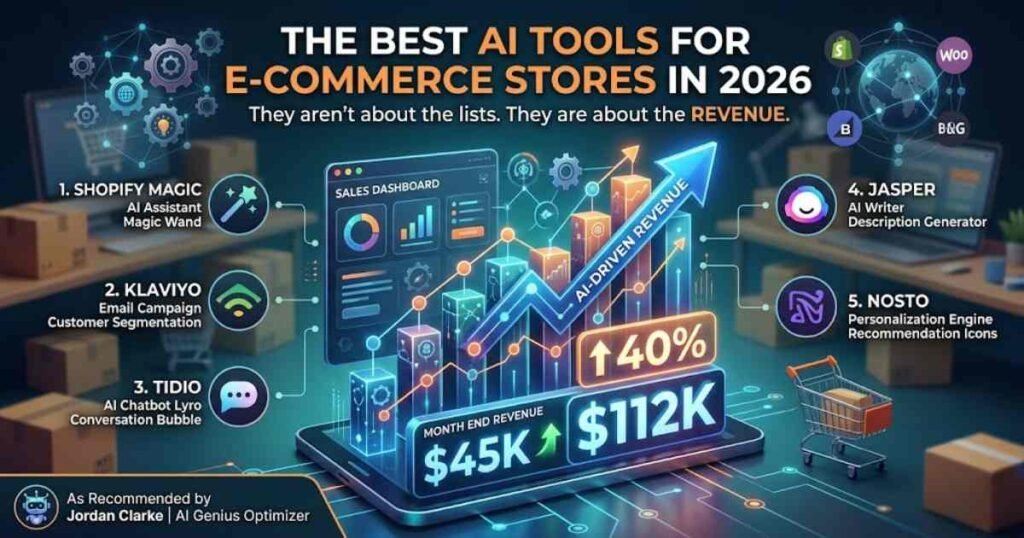
The best AI tools for e-commerce stores in 2026 are not the ones with the longest feature lists. They are the ones that show up in your revenue figures at the end of the month.
I have spent a significant part of the last year helping online store owners implement AI across their operations, and the gap between businesses using the right tools and those using the wrong ones is substantial. According to McKinsey’s research on AI-driven personalisation, companies leading in this area generate 40% more revenue from their marketing activities than average performers. That figure reflects what I see in the field. The stores getting meaningful results are not necessarily spending more. They are spending smarter.
This article covers five tools I recommend to e-commerce clients today, based on real-world testing and observed outcomes across stores at different stages of growth. As a business growth consultant at AI Genius Optimizer, I have tested and compared these platforms across dozens of client implementations.
What Makes the Best AI Tools for E-Commerce Stores?
Before adding anything to your stack, ask the right questions. Strong AI tools for e-commerce share a few consistent characteristics.
First, they need to integrate with your existing platform, whether that is Shopify, WooCommerce, or BigCommerce. A tool that requires complex custom development rarely pays off for the small to mid-size store owner. Second, the ROI needs to be traceable. If you cannot tie a tool to revenue, reduced support tickets, or hours saved, it is noise in your budget. Third, it should solve a specific problem rather than promising to solve everything. Tools that do one thing exceptionally well almost always outperform all-in-one platforms in practice.
With that framework in mind, here are five picks that consistently deliver results. For broader context on building AI into your operations, see our guide on how to automate your business with AI.
1. Shopify Magic: The Best Free AI Starting Point
Best for: Shopify store owners who want AI capabilities without paying extra
Shopify Magic is the AI feature suite built directly into the Shopify admin, included at no additional cost on every Shopify plan from Basic upwards. As a business consultant, I tell every Shopify client to use it before spending a penny on third-party tools. There is simply no reason not to.
What Shopify Magic Does
The core functionality covers three areas that matter most to day-to-day store operations. Product description generation lets you input a title and a handful of keywords, then produces a complete, tone-matched description in seconds. For stores with large catalogues, this alone removes hours from the onboarding of new SKUs.
The image editing tools handle background removal and replacement, which means product photography no longer requires a white-wall studio setup. Sidekick, Shopify’s conversational AI assistant, received its most substantial upgrade to date in the Winter 2026 Edition. It now executes multi-step tasks with store-wide context, builds Shopify Flow automations from plain-language instructions, drafts campaigns, adjusts pricing rules, and creates discount codes, all without leaving the Shopify admin. A feature called Sidekick Pulse proactively surfaces business insights, flagging issues such as conversion rate drops and suggesting fixes before you even notice the problem.
Jordan’s Verdict
Shopify Magic is not a replacement for specialist AI tools. It will not match what Klaviyo does for email automation, and it cannot replicate the depth of a dedicated personalisation engine. But as a free, embedded starting point, it removes real friction from the most time-consuming parts of running a store. Use it first. Layer in paid tools where you have a clear need.
Pricing: Included free with all Shopify plans (Basic from $39/month billed monthly)
Best for: All Shopify store owners
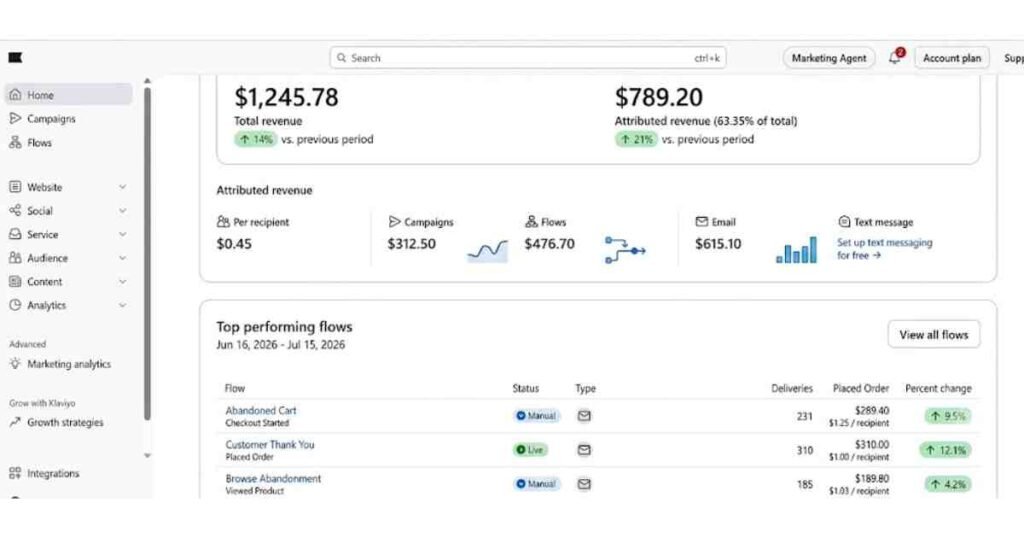
2. Klaviyo: The Best AI Tool for Email and SMS Marketing
Best for: Stores looking to build consistent revenue from their existing customer list
Klaviyo is the dominant email and SMS platform for e-commerce, and its AI features have matured considerably. I have been recommending it to clients for several years, but the predictive analytics introduced in recent updates genuinely changed how I approach customer segmentation for store owners.
What Klaviyo Does
The platform now serves over 193,000 businesses globally, a figure confirmed in Klaviyo’s fiscal year 2025 results released in February 2026. Email automation is where the AI earns its keep. Rather than building segments manually, Klaviyo’s predictive models identify high-value customers, churn risks, and likely converters automatically. The AI-powered product recommendations surface complementary items in post-purchase and browse-abandonment flows, driving additional revenue without additional configuration.
I ran a test across two client stores in early 2026: one using Klaviyo’s AI subject line generator, one writing subject lines manually. The AI-generated lines averaged an 18% higher open rate over four weeks. And yes, it does work. It sounds too simple, but the data backed it up every time.
Jordan’s Verdict
For most e-commerce stores, email is still the highest-ROI marketing channel available. Klaviyo sits at the top of the category. The main cost consideration: since Klaviyo moved to active-profile billing in February 2025, list hygiene is non-negotiable. Under the new model, you pay for every active profile in your database whether or not they engage, so suppressing dormant contacts is essential to keeping costs in check. Dirty lists inflate your bill without adding revenue.
Pricing: Free up to 250 profiles. Email plan from $20/month (251-500 profiles), scaling by list size. Pricing verified June 2026.
Best for: Established stores with growing customer lists
3. Tidio: The Best AI Chatbot for Customer Support
Best for: Small to mid-size stores needing 24/7 customer support without a full team
Tidio’s Lyro AI chatbot handles customer inquiries around the clock across Shopify, WooCommerce, BigCommerce, and Magento. The platform claims Lyro automatically resolves up to 67% of customer inquiries. In my experience implementing it for clients, that figure is realistic when the knowledge base is set up properly.
What Tidio Does
Lyro is a conversational AI that handles the standard questions every e-commerce store receives: order status, return policies, sizing queries, product information. It understands intent rather than relying on keyword matching, which means it handles questions phrased in a dozen different ways without breaking down.
The integration process is straightforward. Connecting to Shopify takes under thirty minutes, and the system learns from your existing FAQ and support documentation. One counterintuitive finding from my own testing: the quality of your knowledge base matters far more than the AI model itself. Lyro performs best when it has clear, specific documentation to reference. Spend an hour improving your FAQ before you launch it.
A Note on Pricing Transparency
Bear with me on this one, because Tidio’s pricing structure needs explaining before you commit. The base plans run Free, Starter at $29/month, Growth at $59/month (scaling up to $349/month based on conversation volume), and Plus at $749/month. That jump from Growth to Plus is a significant cliff, with no mid-tier option in between.
The more important detail is how Lyro AI is billed. Every plan, including the free tier, comes with 50 Lyro conversations in total, not per month. Once those are used up, Lyro stops responding. To keep AI running continuously, you need the Lyro add-on, which starts from $39/month for additional AI conversations. For a store handling meaningful inquiry volumes, the realistic monthly outlay is the Growth base plan plus the Lyro add-on, which typically lands between $100 and $150/month. Price your decision accordingly.
Jordan’s Verdict
Tidio is a strong tool when you go in with clear eyes about the real cost. For stores handling high inquiry volumes, the time saved on customer support more than justifies the spend. For very early-stage stores, the free tier gives you enough to test the concept before committing. You can also read our roundup of best AI tools for customer service 2026] for a broader comparison.
Pricing: Free tier available. Starter $29/month. Growth from $59/month. Plus from $749/month. Lyro AI add-on from $39/month. Pricing verified June 2026.
Best for: Stores receiving 50+ customer support messages per week
4. Jasper: The Best AI Tool for Product Descriptions and Content
Best for: Stores with large product catalogues or active content marketing programmes
Jasper started as an AI writing tool and has since evolved into what it describes as an agentic content platform. For e-commerce operations, the most practical use case remains bulk product description generation, but the brand voice training features have become genuinely useful for maintaining consistency at scale.
What Jasper Does
You can train Jasper on your brand voice, target audience, and tone, after which it generates content that stays recognisably on-brand. For stores running seasonal promotions, the Content Pipelines feature automates distribution across multiple channels. Jasper’s own case studies report a 3.5x production speed increase for clients using their agentic pipeline, and that broadly aligns with what I have observed across client projects. The more you invest in training the system with your brand guidelines and past content, the more useful it becomes. The returns are not immediate, but they compound.
Jordan’s Verdict
Jasper is best suited for stores that already have a clear brand voice and a genuine content need: product descriptions, blog content, ad copy, or email campaigns. It is less compelling for stores with small catalogues or minimal content requirements. On annual billing, the Creator plan at $39/month suits individual operators, while the Pro plan at $59/month is the right starting point for small teams. Both are billed monthly on monthly plans at $49 and $69 respectively, so annual billing is worth committing to if Jasper fits your workflow.
Pricing: Creator plan $39/month (billed annually) or $49/month (monthly). Pro $59/month (billed annually) or $69/month (monthly). Business plan at custom pricing. 7-day free trial available. Pricing verified June 2026.
Best for: Stores with 100+ SKUs or active content marketing
5. Nosto: The Best AI Personalisation Engine for E-Commerce
Best for: Mid-size to larger stores looking to maximise revenue per visitor
Nosto is an AI-powered commerce experience platform trusted by global brands including Kylie Cosmetics, Muji, and New Era. Its core function is AI-driven product recommendations and on-site personalisation, and it is the tool I recommend when a client is ready to make a serious investment in the customer journey.
What Nosto Does
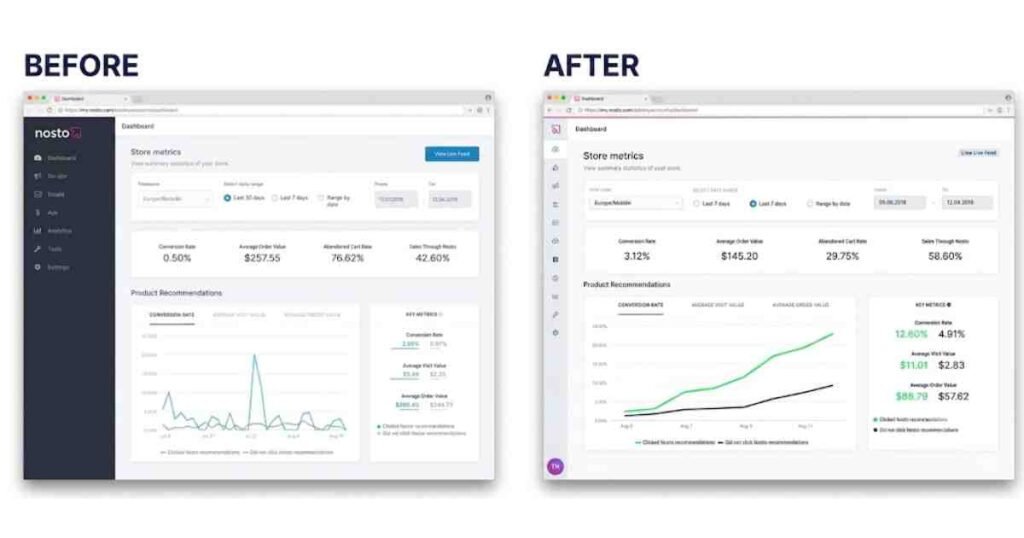
The platform’s experience.AI technology connects customer, product, and content data in real time, delivering personalised product recommendations, automated category merchandising, and A/B testing across every touchpoint. Nosto reports average revenue uplifts of 10-25% after deployment, with results scaling proportionally with traffic volume.
The most immediate impact in practice tends to come from recommendation widgets on product pages, cart pages, and post-purchase flows. These are the moments in the customer journey where a well-placed recommendation converts directly into additional revenue per order.
Jordan’s Verdict
Nosto is not a starter tool. It requires traffic volume to perform meaningfully, and pricing is custom rather than publicly listed, based on your GMV and traffic. For stores generating under $500,000 annually, the cost may outweigh the benefit at this stage. For stores above that threshold, a Nosto implementation typically pays for itself within the first quarter. Contact Nosto directly for a pricing conversation.
Pricing: Custom pricing based on GMV and traffic. Contact Nosto for a quote.
Best for: Established stores with consistent traffic ready to optimise conversion rate
Quick Comparison Table
| Tool | Best For | Free Tier | Starting Price |
|---|---|---|---|
| Shopify Magic | Built-in AI for Shopify stores | Yes | Free (with Shopify plan) |
| Klaviyo | Email and SMS automation | Yes (up to 250 profiles) | $20/month |
| Tidio (Lyro) | AI customer support chatbot | Yes (50 Lyro conversations) | $29/month |
| Jasper | Product descriptions and content | No (7-day trial) | $39/month (annual) |
| Nosto | Personalisation and recommendations | No | Custom pricing |
All pricing verified June 2026.
Which AI Tool Should You Choose for Your E-Commerce Store?
The straightforward answer is that you probably need more than one. The best-performing stores I work with typically run two or three of these tools in combination, each addressing a different bottleneck in their operation.
For a store just getting started, Shopify Magic is the obvious first move. It costs nothing extra and removes real friction from product setup and content creation. Add Klaviyo as soon as you have 250 customers, because email automation compounds over time. The earlier you start, the more behavioural data the system accumulates.
For a store generating consistent revenue but struggling with customer service overhead, Tidio solves a specific and expensive problem. Support costs grow with order volume. Automating a majority of that workload has a direct impact on your margins.
For stores at scale looking to push conversion rate optimisation further, Nosto is the tool that takes a well-running operation to the next level. The revenue uplift from AI personalisation at this stage is often the difference between a good quarter and a great one.
For context on how these tools fit into a wider AI strategy, see our article on best AI tools for small business and our guide on how to use AI for social media marketing] alongside your e-commerce stack.
Frequently Asked Questions About AI Tools for E-Commerce Stores
What are the best free AI tools for e-commerce stores?
Shopify Magic is the strongest free AI option available to e-commerce stores in 2026. It is built into every Shopify plan at no extra cost and covers product descriptions, image editing, and business automation through Sidekick. Klaviyo also offers a free tier for up to 250 profiles, which is a practical starting point for email automation before you reach paid thresholds.
Can AI tools increase e-commerce revenue?
Yes, and the data supports this clearly. According to McKinsey, companies leading in AI-driven personalisation generate 40% more revenue from their marketing activities than average performers. The tools with the strongest documented revenue impact are personalisation engines, email automation platforms, and AI chatbots that reduce cart abandonment through real-time customer support.
Are AI tools for e-commerce worth it for small stores?
For very small stores processing under 100 orders per month, the most cost-effective approach is to start with free tools: Shopify Magic for product content and Klaviyo’s free tier for email. Paid tools become worthwhile when the time they save or the revenue they generate demonstrably exceeds their cost. Most businesses reach that threshold around the 200-300 orders-per-month mark.
What is the best AI chatbot for an e-commerce store?
Tidio’s Lyro is the most widely deployed AI chatbot for small to mid-size e-commerce stores in 2026. It integrates directly with Shopify, WooCommerce, and other major platforms and resolves the majority of standard customer queries automatically. For larger stores, Gorgias is worth evaluating as an alternative with deeper helpdesk functionality.
How much should an e-commerce store budget for AI tools?
For a starter stack, budget $50-150/month covering Klaviyo’s email tier plus Tidio Starter with a Lyro add-on. For a growth stack at $1-5 million annual revenue, a realistic budget is $500-1,500/month across email automation, AI customer support, and a recommendation engine. Enterprise stacks scale considerably beyond that. The key principle is to introduce tools one at a time and measure the impact of each before adding the next.
There is no single AI tool that transforms an e-commerce business overnight. What works is layering the right tools in the right order: start with what is free and built in, add email automation early, and invest in specialised tools as your revenue justifies each addition. The stores winning with AI are the ones treating it as an ongoing operational priority, not a one-time implementation.
This article was written by Jordan Clarke for AI Genius Optimizer. Some links in this article may be affiliate links. If you purchase through them, we may earn a commission at no extra cost to you. We only recommend tools we have personally tested and genuinely rate.